Regional Transport Model Network Quality Improvement
Regional Transport Model Network Quality Improvement
Network Quality and Model Reliability
In regional transport models, network quality directly affects the reliability of model outputs. In a regional transport model in the Netherlands, numerous junctions were generating errors during traffic assignment, compromising the integrity of assignment results and reducing confidence in subsequent model-based assessments. The issues fell into three categories: incorrectly entered attributes, including turn penalties, direction definitions, capacity, priority, signalisation and roundabout type; geometric and topological defects, such as links not fully connected to nodes, duplicate nodes and unintended splits; and structural limitations within the modelling software.
Iterative Review and Correction
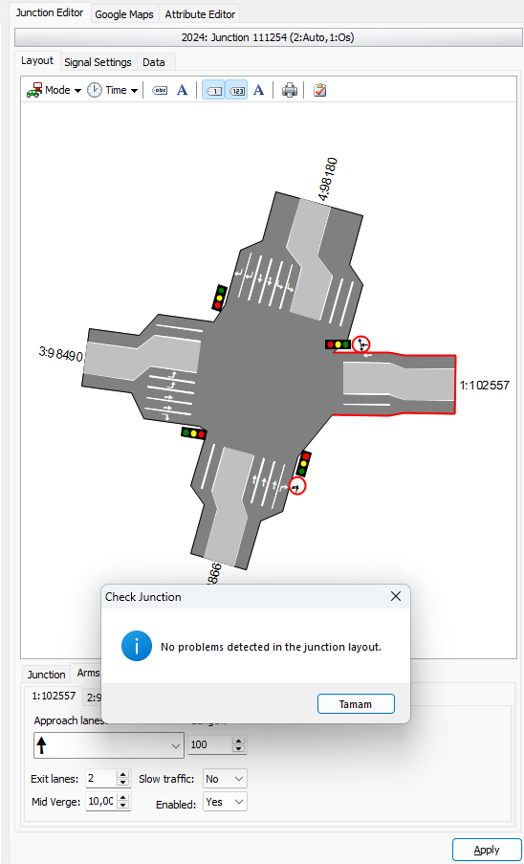
The work began with the model’s diagnostic log. Junctions generating errors were prioritised, visually reviewed using Google Street View and compared with field conditions in the model’s base year. Corrections addressed node and link geometry, connectivity, direction and turn restrictions, and junction coding across all mode and time combinations.
Junctions that could not be represented within the existing model structure were reconfigured by splitting them into subnodes. Traffic assignment was rerun throughout the process, with iterative testing continuing until all related error messages had been eliminated. Scope discipline was a central principle: only changes required to resolve the identified errors were made, with no other modifications introduced to the model.
A Model Free of Junction Errors
By completion, the model’s traffic assignment ran without any junction-related error messages. The corrected final model was delivered alongside a change log documenting what was changed and why, supported by before-and-after images for each intervention. The resulting improvement in network quality provided a more robust basis for all subsequent scenario assessments and investment analyses built on the model.